When the Operator Loses Control, Does Your Blast Nozzle Actually Stop?
The Problem
When an operator releases the deadman control, the deadman turns off the blast controls, but the energy stored in the pressurized blast hose still needs to escape. In conventional systems, this pressure can only be released through the blast nozzle. Depending on the size and length of the blast hose and nozzle, depressurization can take 10 to 15 seconds. In an emergency, such as a slip, trip or fall, this delay can expose operators to serious injury.
Following established abrasive blasting safety guidance is essential, but equipment response time also plays a critical role in protecting operators.
Here’s why Schmidt ASAP PnP reduces shutdown time to less than one second under typical operating conditions.
Why Conventional Systems Are Slow
In a conventional blasting system, the blast hose remains pressurized even after the control valves close at the blast unit. The residual pressure must escape through the nozzle, which can significantly delay complete depressurization.
This delay can become especially concerning when operators lose control of the nozzle or when the nozzle becomes blocked or obstructed. A faster shutdown process helps reduce the time that stored pressure remains in the hose.
How Schmidt ASAP PnP Closes the Gap
The Schmidt ASAP PnP (Plug and Play) provides faster shutdown of blasting nozzles by creating a dedicated exhaust pathway. Instead of requiring residual blast hose pressure to escape through the nozzle, ASAP PnP directs that pressure through an Exhaust Module.
This approach helps address a critical limitation of conventional systems while offering a plug-and-play upgrade for existing equipment. Schmidt also offers a range of abrasive blasting valves and controls to support different blasting system configurations.
We ran a side-by-side test on 200 feed of blast hose
The result:
- Faster shutdown: Blast nozzles typically shut down in less than one second, with air released through the dedicated ASAP Exhaust Module.
- Controlled pressure release: The dedicated exhaust pathway provides a cleaner, more controlled shutdown.
- Plug-and-play upgrade: The system integrates with existing blast pots without requiring major modifications.
- Reduced risk from trapped pressure: ASAP PnP eliminates blast hoses remaining pressurized when a blast nozzle becomes blocked or obstructed.
Proof From the Field
Testimonial from Abrasive Blast Supply
We recently demonstrated Schmidt’s new ASAP PnP with a water tower blasting crew that typically runs 200 to 250 feet of blast hose.
During our warehouse demo, we tested the system using 200 feet of blast hose and compared it with their existing setup featuring Thompson II grit valves and an electric deadman. The results were impressive: their current system took approximately 12 seconds to blow down, while ASAP PnP completed the process in less than 2 seconds.
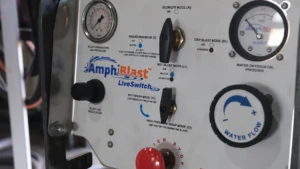
The operator quickly adapted to the three-position switch, making the system easy to learn and operate. But the biggest impression came from the dramatic improvement in blowdown speed. The foreman’s reaction said it all: he kept repeating, “That’s insane!”
ASAP PnP delivered a significant improvement in the time required to depressurize the blast hose, and the crew was impressed with both its speed and ease of use.
Every Blast System Should Respond This Fast
A blast system is only as safe as its ability to respond when an operator releases the deadman. On a conventional system, depressurization can take multiple seconds, which may be long enough for a serious injury when an operator loses control.
With ASAP PnP, shutdown is typically achieved in less than one second under the stated operating conditions. By providing a dedicated pathway for releasing residual blast hose pressure, the system helps deliver the rapid response operators need.
For crews evaluating their existing equipment, Schmidt’s ASAP II Safety System offers another relevant solution to explore for blast hose depressurization and safety. Operators can also review Schmidt’s G3 Trigger Deadman control as part of a broader evaluation of their blasting controls.
For replacement components and compatible equipment, Schmidt’s blasting equipment parts catalog provides another resource for maintaining existing systems.
When it comes to abrasive blasting safety, shutdown speed matters. Schmidt ASAP PnP helps reduce the time required to release residual blast hose pressure, giving operators a faster, more controlled response when it matters most.